
The Enigma of the Feathered Petal
Few spring flowers create such immediate drama as a tulip whose petals appear brushed with flame. A pale ground may carry crimson flames, violet feathers, or irregular splashes that seem painted rather than grown. In a crisp border, these blooms catch the light from every direction, changing as the petals open and making even a small planting look like a living tapestry.
That visual effect once carried a dangerous secret. During the seventeenth-century Dutch tulip trade, the most admired “broken” tulips were prized precisely because their colours had separated into extraordinary patterns. The famous Semper Augustus, associated with white petals marked by brilliant red flames, became a symbol of scarcity and speculation. Modern gardeners can still enjoy the appearance, but the safest route is through stable cultivars bred for inherited colour patterns, not through infected bulbs. That distinction is central to choosing healthy stock and protecting a garden from disease.
Tulip Mania and the Invisible Intruder
The Semper Augustus occupied a special place in the mythology of tulip mania. Its white petals were dramatically streaked and feathered with red, and surviving accounts describe bulbs changing hands for sums far beyond ordinary horticultural value. The flower”s appeal was not simply its rarity. Each bloom looked individual, as though pigment had been swept across the petals with a fine brush. In a period when tulips were already novel luxury plants, such unpredictable markings encouraged collectors to treat particular bulbs as living treasures.
The irregular colour was caused by infection, not by a harmless decorative trait. An aphid could acquire the virus while feeding on an infected plant and then carry it to a healthy tulip. Once introduced into a nursery bed, the pathogen could move quietly through the stock. Understanding the botanical pathology begins with how the historic tulip breaking virus disrupts petal pigmentation, particularly the distribution and intensity of anthocyanins, the pigments responsible for many red, purple, and violet tones.
In an infected flower, the colour pattern could be spectacular, but the plant was not necessarily healthy. Virus-affected bulbs often lost vigour over time. Successive generations might produce smaller bulbs, weaker stems, reduced offsets, and less dependable flowers. The same infection that created a desirable broken pattern could gradually drain the planting of strength. In commercial beds, this made infected material a serious threat, since propagation multiplied both the prized appearance and the pathogen. A bloom that looked more valuable could therefore represent a plant moving toward decline.
Viral Pathology Versus Stable Genetics
A virus changes the way a plant”s cells function, including the way pigment is produced or distributed in the petals. The resulting pattern is an acquired symptom, not a reliable genetic instruction passed cleanly from one healthy generation to the next. Its expression may vary with plant age, environmental conditions, and the degree of infection. By contrast, modern stable cultivars carry inherited genetic combinations that regulate flower colour and form without requiring disease. Their markings are part of the plant”s breeding identity, not evidence of a spreading pathogen.
Plant pathology in the twentieth century made the difference increasingly clear. Commercial tulip growers adopted inspection, removal of suspicious plants, sanitation, and isolation practices to limit the movement of viruses through valuable stocks. For the home gardener, the practical lesson is straightforward: never seek a broken effect by purchasing a visibly weak or questionably sourced bulb. Choose named cultivars from reputable suppliers, discard bulbs that are soft or rotting, and keep unusual symptoms out of a healthy planting.
| Feature | Virus-induced breaking | Stable modern cultivar |
|---|---|---|
| Cause | Infection that alters pigment distribution | Inherited genetic traits selected through breeding |
| Plant vigour | May decline as infected stocks weaken | Generally dependable when planted in suitable conditions |
| Pattern | Variable, irregular, and disease-associated | Consistent with the cultivar”s normal flower form |
| Garden risk | Can spread through insect feeding and plant material | Does not spread as an infection |
| Best response | Isolate and remove suspect plants | Grow, label, and divide displays according to normal bulb care |
Modern Flamed Cultivars Worth Planting
Modern “Rembrandt-style” tulips provide the visual language of historic broken tulips without asking the gardener to tolerate a diseased plant. Breeders selected stable combinations of base colour, feathering, and contrasting streaks, especially within Triumph and Single Late groups. These tulips tend to offer stronger stems and more predictable flowering than the fragile historic types. Their patterns may be bold rather than perfectly uniform, but that controlled variation is part of their charm.
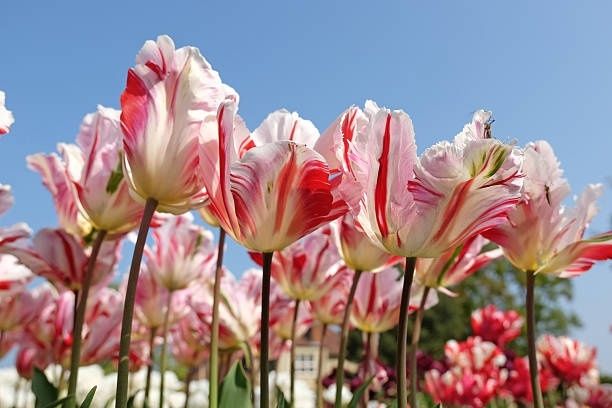
Parrot tulips take the effect in a more theatrical direction. Their petals may be deeply cut, twisted, curled, or fringed, and their colour often arrives in broad splashes rather than narrow stripes. Because the expanded flowers can act like sails in exposed weather, they perform best where spring winds are moderated. Planting them among sturdy companions or near a sheltered wall helps preserve the petal edges long enough for the display to be enjoyed at its fullest.
When choosing bulbs, look beyond the catalogue photograph. Check the stated group, expected flowering time, mature height, and bulb size, then select a combination that distributes interest through the season. Strong, firm bulbs are more important than an especially large printed bloom. The following cultivars are useful starting points for a stable flame effect:
- Sorbet offers a striking striped and feathered appearance, with contrasting colour that reads clearly from a short distance.
- Carnival de Nice is a double-flowered type with dramatic red and white markings, useful for a richly layered border or cutting display.
- Estella Rijnveld is a well-known red and white Parrot tulip, valued for its deeply cut petals and vivid, irregular colour pattern.
- Rembrandt-style Triumph selections suit gardeners who want a more structured flower and sturdy stems for beds, containers, or vase cutting.
- Single Late selections with stable feathering extend the display and can provide height behind earlier spring bulbs.
Autumn Planting Protocols for Flawless Spring Color
Tulips establish roots in cool soil, so autumn planting should be guided by soil conditions rather than a single calendar date. In many temperate gardens, bulbs are planted after the soil has cooled below roughly 15°C, often from mid-autumn into early winter. The ground should remain workable, however, because bulbs placed into cold, waterlogged soil are more vulnerable to rot. In colder climates, planting early enough for root development before the soil freezes is important; in mild climates, later planting can reduce the time bulbs spend in warm, damp ground.
Plant depth is usually measured from the base of the bulb to the soil surface. A practical rule is to plant at approximately two to three times the bulb”s height, with many tulips settling well at about 15 to 20 centimetres deep. Heavy clay may call for a slightly shallower position, while light, sandy soil can permit deeper planting. Spacing of approximately 10 to 15 centimetres gives individual bulbs room to develop while still creating a full drift. Containers require excellent drainage and should not be allowed to sit in saucers of standing water.
- Choose the bed carefully. Select a position with full sun during the main growing season, ideally receiving at least six hours of direct light. A sheltered site protects Parrot and fringed petals from drying winds.
- Test the drainage. Dig a planting hole or trial trench and observe whether water remains after rain. Improve heavy ground with organic matter and, where appropriate, a raised bed or mound. Do not place a bulb directly into a pocket of compost that holds moisture.
- Prepare a clean root run. Remove perennial weeds, break up compacted soil, and create a firm but friable base. Healthy bulbs reward careful planting because roots need both moisture and air.
- Inspect every bulb. Set aside bulbs that are soft, leaking, mouldy, or badly damaged. Sound bulbs should feel firm, with intact outer skins and no expanding brown lesions.
- Set bulbs with the pointed end upward. Place them at the appropriate depth and space them evenly for a natural drift. Avoid pressing them into sharply compacted soil, which can damage the basal plate.
- Backfill and water once. Water after planting if the soil is dry, allowing the soil to settle around the roots. After that, let rainfall guide the task and avoid repeated watering unless conditions remain unusually dry.
- Protect the bed through winter. A light mulch can moderate temperature changes, but keep it loose and avoid burying the planting under a dense, wet layer. In containers, move pots beside a sheltered wall while maintaining drainage.
Microclimate matters most when the petals open. A south-facing site may encourage earlier flowering, while a position with morning sun and afternoon protection can preserve delicate colour in regions prone to sharp temperature swings. Avoid exposed ridges and narrow wind corridors. If spring storms are common, plant tall Parrot cultivars behind sturdy perennials or low shrubs that filter wind without creating deep shade. The goal is not to hide the flowers, but to prevent gusts from shredding the very fringes that make them distinctive.
Bring Timeless Living Tapestries to Your Spring Garden
The history of broken tulips illustrates both the seduction and the danger of unusual plant traits. Viral infection once produced patterns that collectors considered priceless, but the same infection weakened bulbs and threatened entire stocks. Modern breeding has separated the visual effect from the disease. Stable genetics now allow gardeners to grow feathered, flamed, and splashed flowers with far greater confidence, provided the bulbs are sound and the bed is well prepared.
Layer several cultivars rather than relying on one dramatic variety. Combine earlier Triumph tulips with later Single Late selections, then place Parrot forms where their petals can be seen from a path or protected seating area. Give bulbs the conditions they are asking for, avoid soggy soil, and protect next season”s bloom by leaving foliage in place until it yellows naturally. From bulb to bloom, the reward is a display that feels historic without repeating history”s botanical mistake: painted petals opening safely beneath the clear light of April.